
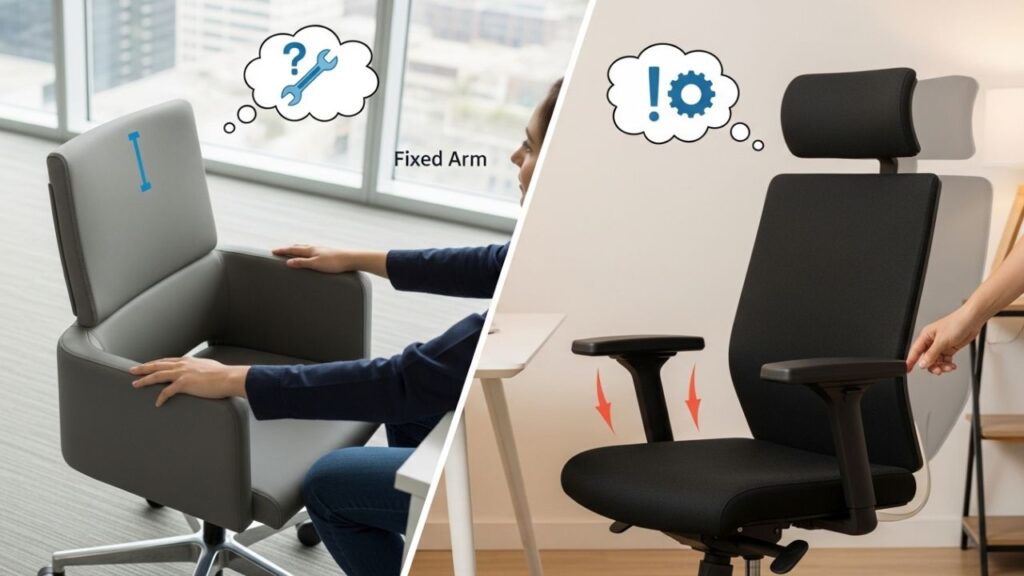
Why Do So Many Office Chairs Have Fixed Arms? Understanding the Design Choice
If you’ve ever shopped for office furniture, you may have noticed that many models come with fixed armrests rather than adjustable ones. This design choice is not accidental. The reason so many office chairs have fixed arms is a combination of cost efficiency, durability, ergonomic trade-offs, and mass-market practicality.
To understand this better, we need to look at how office chairs are designed, manufactured, and used in real-world environments.
The Role of Armrests in Office Chair Design
Armrests are meant to support the arms, reduce shoulder strain, and improve posture during long working hours. In ergonomic design, they help distribute weight and reduce pressure on the spine and neck.
However, not all armrests are created equal. In many office chairs, manufacturers choose fixed designs over adjustable ones to balance performance with affordability and reliability.
Cost Efficiency and Mass Production
One of the biggest reasons why so many office chairs have fixed arms is cost.
Lower Manufacturing Costs
Fixed armrests require:
- Fewer moving parts
- Simpler molds and assembly
- Less hardware and adjustment mechanisms
This significantly reduces production costs, allowing companies to sell chairs at competitive prices.
Affordable for Bulk Buyers
Many office chairs are purchased in bulk by businesses, schools, and call centers. For large orders, even small cost differences per unit matter. Fixed-arm designs help keep budgets under control while still providing basic comfort.
Durability and Reduced Maintenance
Another key reason is durability.
Fewer Moving Parts = Fewer Failures
Adjustable armrests often include:
- Sliding mechanisms
- Locking systems
- Height and angle joints
These parts can wear out over time. Fixed arms eliminate these weak points, making the chair more durable in high-use environments.
Ideal for Heavy Usage Settings
In places like offices or public workstations where chairs are used daily by multiple people, durability becomes more important than customization.
Ergonomic Trade-Offs
While adjustable armrests are often better for personalized comfort, fixed arms still meet general ergonomic standards when designed properly.
Designed for Average Body Dimensions
Manufacturers typically design fixed-arm chairs based on:
- Average user height
- Standard desk height
- Common arm positioning angles
This ensures that most users will find the chair “good enough” without needing adjustments.
Stability Over Flexibility
Fixed arms provide a stable resting position, which can help maintain consistent posture during work.
Simplicity in Design and User Experience
Simplicity is another major factor behind the widespread use of fixed armrests.
No Adjustments Needed
With fixed arms:
- Users don’t need to learn adjustment mechanisms
- There’s no confusion about settings
- The chair is ready to use immediately
Fewer User Errors
In workplaces, adjustable features are sometimes misused or left improperly configured. Fixed arms eliminate this problem entirely.
Space Efficiency in Office Layouts
Office environments often prioritize space optimization.
Compact Design
Fixed-arm chairs are often:
- Narrower
- Easier to align under desks
- Better suited for tight workstations
Consistent Seating Arrangement
In shared environments, uniform chair sizes make it easier to organize desks and maintain consistent layouts.
Why Adjustable Arms Are Not Always Necessary
While adjustable armrests offer more customization, they are not always essential for every type of user.
Fixed arms are often sufficient when:
- Work is short to medium duration
- Users have similar body types
- Tasks do not require frequent posture changes
For many standard office environments, the added complexity of adjustable arms may not provide enough benefit to justify the cost.
Where Fixed-Arm Chairs Are Most Common
You’ll most often see fixed-arm designs in:
- Call centers
- Educational institutions
- Government offices
- Budget-friendly home office setups
- Conference rooms
In contrast, high-end executive chairs or ergonomic specialty chairs are more likely to feature fully adjustable arm systems.
The Balance Between Cost, Comfort, and Function
The decision to use fixed arms is ultimately about balancing three key factors:
1. Cost
Lower price makes chairs accessible to more buyers.
2. Comfort
Adequate support for average users without customization.
3. Functionality
Reliable, durable, and easy-to-use design.
Manufacturers often choose fixed arms because they provide the best overall compromise for mass-market needs.
Future Trends in Office Chair Design
As workplace ergonomics evolve, we are seeing new trends:
- More hybrid designs with semi-adjustable armrests
- Modular chairs with optional upgrades
- Increased focus on ergonomic health standards
- Smart chairs with posture monitoring features
However, fixed-arm chairs are likely to remain popular due to their simplicity and affordability.
Conclusion
So, why do so many office chairs have fixed arms? The answer lies in practicality. Fixed armrests reduce manufacturing costs, increase durability, simplify design, and meet the needs of most users in standard office environments.
While they may not offer the flexibility of adjustable designs, they strike a strong balance between comfort, stability, and affordability—making them a common choice in workplaces around the world.