
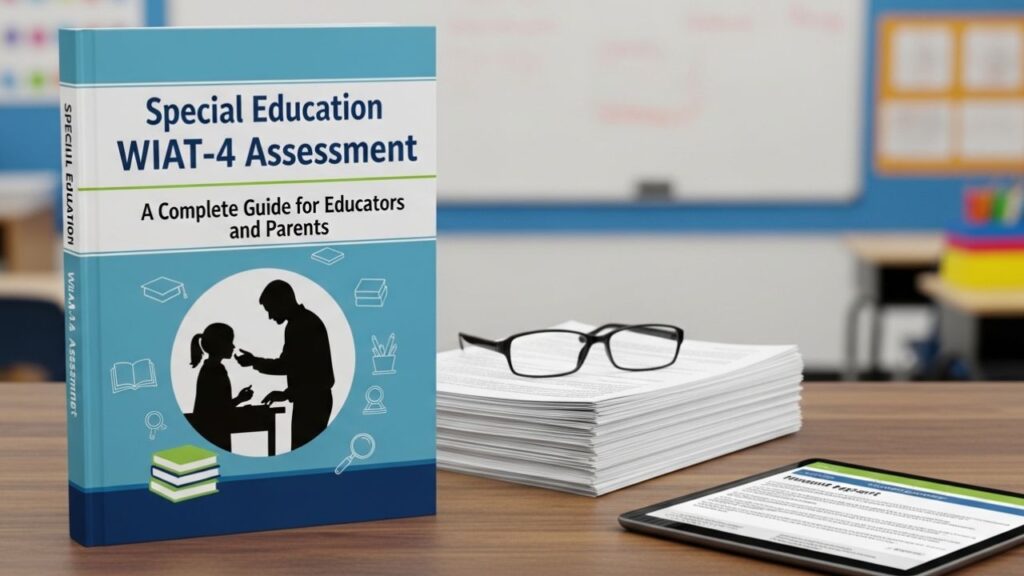
Special Education WIAT-4 Assessment: A Complete Guide for Educators and Parents
The Special Education WIAT-4 assessment (Wechsler Individual Achievement Test – Fourth Edition) is a widely used tool designed to measure a student’s academic achievement. It plays a crucial role in special education by identifying learning strengths, weaknesses, and academic skill levels.
Educators, psychologists, and specialists use this assessment to better understand how a student performs in areas such as reading, writing, mathematics, and oral language. The results help create individualized education plans (IEPs) that support student success.
What Is the Special Education WIAT-4 Assessment?
The Special Education WIAT-4 assessment is a standardized academic test that evaluates a student’s current educational performance. It is designed for individuals from early childhood through adulthood.
Unlike intelligence tests, WIAT-4 focuses specifically on academic skills rather than cognitive ability. It provides detailed insights into how well a student is performing in school-related tasks.
Purpose of the WIAT-4 in Special Education
The main goal of the Special Education WIAT-4 assessment is to support educational planning and intervention. It helps:
- Identify learning disabilities
- Measure academic achievement levels
- Guide Individualized Education Programs (IEPs)
- Monitor academic progress over time
- Support eligibility decisions for special education services
This makes it an essential tool for both diagnosis and ongoing educational support.
Key Areas Measured in WIAT-4
The Special Education WIAT-4 assessment evaluates several academic domains:
Reading Skills
This section measures:
- Reading comprehension
- Word recognition
- Reading fluency
It helps determine how well a student understands and processes written text.
Writing Skills
Writing subtests assess:
- Spelling
- Sentence composition
- Essay writing ability
These tasks show how effectively a student can express ideas in written form.
Mathematics Skills
The math section includes:
- Basic math operations
- Problem-solving skills
- Numerical reasoning
It evaluates both computational and applied math abilities.
Oral Language
This area measures:
- Listening comprehension
- Oral expression
- Vocabulary knowledge
It helps assess how well a student understands and uses spoken language.
How the WIAT-4 Assessment Is Administered
The Special Education WIAT-4 assessment is typically administered one-on-one by a trained professional such as a school psychologist or educational specialist.
The process involves:
- Selecting age-appropriate subtests
- Administering tasks verbally or in written form
- Recording student responses
- Scoring based on standardized norms
The entire assessment may take between 1 to 2 hours depending on the number of subtests used.
Scoring and Interpretation of WIAT-4
Scores from the Special Education WIAT-4 assessment are compared to national age-based norms. This helps determine whether a student is performing:
- Above average
- Average
- Below average
The results are often presented in standard scores, percentile ranks, and age equivalents. These scores help educators make informed decisions about instructional support.
Importance of WIAT-4 in Special Education
The Special Education WIAT-4 assessment is essential because it provides:
Accurate Academic Profiling
It gives a detailed breakdown of academic strengths and weaknesses.
Support for Individualized Learning Plans
Teachers use results to design targeted instruction for students with learning challenges.
Early Identification of Learning Difficulties
It helps detect issues such as dyslexia, dysgraphia, or math-related difficulties early.
Progress Monitoring
Repeated assessments can track improvement over time.
Who Should Take the WIAT-4 Assessment?
The Special Education WIAT-4 assessment is suitable for:
- Students suspected of learning disabilities
- Students struggling academically
- Individuals requiring special education services
- Students undergoing educational evaluations
It is used across schools, clinics, and psychological assessment centers.
Benefits of the WIAT-4 Assessment
- Provides comprehensive academic evaluation
- Helps guide personalized teaching strategies
- Supports special education eligibility decisions
- Identifies specific learning needs
- Assists in long-term academic planning
Limitations of the WIAT-4 Assessment
While valuable, the Special Education WIAT-4 assessment also has limitations:
- It measures academic performance, not intelligence
- Results may be influenced by test anxiety or fatigue
- Requires trained professionals for accurate administration
- May not capture real-world learning skills fully
Conclusion:
The Special Ed ucation WIAT-4 asse ssment is a powerful tool for evaluating academic achievement and supporting students with diverse learning needs. It helps educators and specialists design effective learning strategies tailored to each student’s abilities.
By identifying strengths and areas of difficulty, WIAT-4 plays a key role in improving educational outcomes and ensuring that students receive the support they need to succeed.