
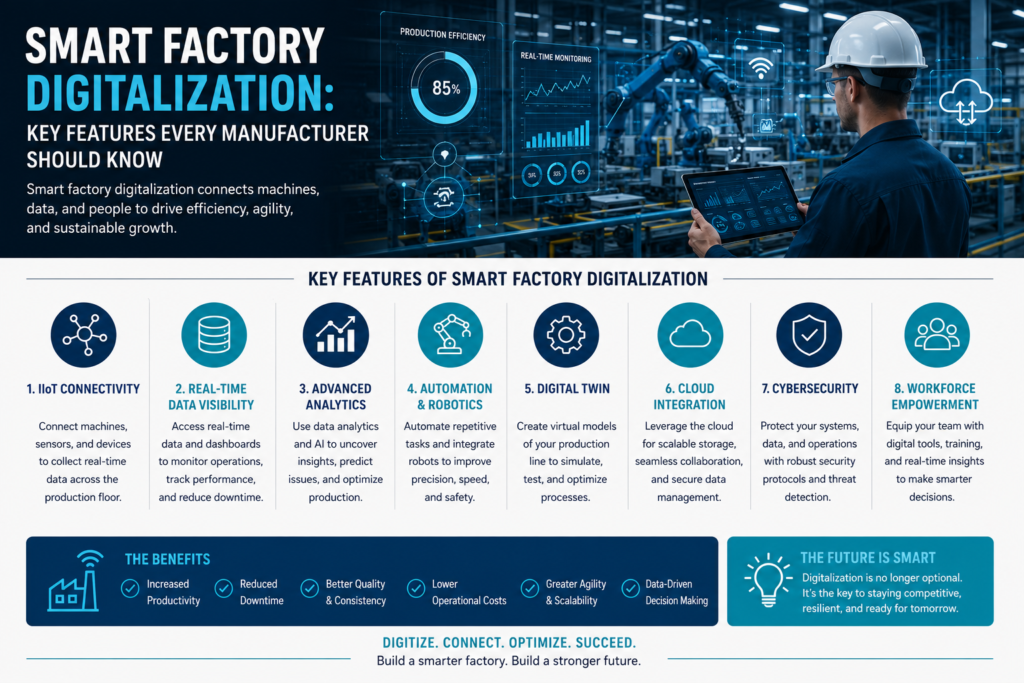
Smart Factory Digitalization: Key Features Every Manufacturer Should Know
Production delays, unexpected equipment failures, rising operating costs, and limited visibility into factory performance continue to challenge manufacturers across industries. Relying on disconnected systems can make it difficult to identify inefficiencies before they affect productivity and profitability.
As manufacturers look for practical ways to improve operations, smart factory solutions for modern manufacturing are becoming an effective approach to digital transformation. By connecting equipment, electrical instruments, and intelligent automation systems, businesses can improve operational efficiency, reduce downtime, and make faster, data-driven decisions.
In this blog, we’ll discover the key features every manufacturer should know before investing in a smart factory.
What is a Smart Factory?
A smart factory is a manufacturing environment where connected equipment, sensors, automation systems, and software continuously exchange information. This enables manufacturers to monitor operations in real time, identify potential issues before they disrupt production, and make informed operational decisions.
Unlike conventional manufacturing facilities that rely on manual supervision, a smart factory incorporates digital technologies. This improves production accuracy, asset utilization, and maintenance planning across the entire facility.
5 Core Features That Drive Smart Factory Digitalization
Several technologies work together to improve manufacturing efficiency, increase operational visibility, and support informed decision-making. The following capabilities form the foundation of a digitally connected manufacturing environment.
1. Connected Industrial Equipment
A smart factory depends on interconnected equipment that communicates through industrial networks. Manufacturers deploy connected equipment to collect production data from electrical instruments, control panels, drives, and monitoring devices.
Continuous communication between systems provides greater visibility into equipment health, production rates, and operational performance, allowing teams to respond quickly when issues arise.
2. Real-time Data Monitoring
Digital manufacturing environments continuously collect operational information from production lines, electrical equipment, and industrial devices. This real-time monitoring helps manufacturers:
- Detect equipment abnormalities before failures occur.
- Monitor production performance continuously.
- Improve maintenance planning.
- Reduce unplanned downtime.
- Support faster operational decision-making.
Access to real-time operational data enables manufacturers to optimize production while minimizing operational disruptions.
3. Automation and Intelligent Control
Automation is a fundamental component of a smart factory. Manufacturers employ programmable logic controllers (PLCs), robotics, and intelligent control systems to perform repetitive operations with greater consistency and precision.
These automated workflows reduce manual intervention, improve production quality, and support higher production throughput while maintaining process consistency.
4. Predictive Maintenance
Traditional maintenance strategies often rely on fixed schedules or reactive repairs. A smart factory incorporates predictive maintenance by analyzing equipment data collected through connected monitoring systems.
Maintenance teams can identify developing issues early and schedule repairs before equipment failures interrupt production, improving equipment reliability while reducing maintenance costs and unplanned downtime.
5. Energy, Asset Management, and Secure Connectivity
Manufacturers incorporate intelligent monitoring systems to track electrical consumption, equipment utilization, and asset performance. By monitoring electrical instruments and connected equipment, facilities can identify inefficiencies, optimize operations, and improve lifecycle management of critical assets.
As manufacturing systems become more connected, cybersecurity becomes essential. A smart factory incorporates secure communication protocols, user authentication, network segmentation, and continuous monitoring to protect operational technology systems and maintain reliable connectivity across industrial devices.
Smart Factory Solutions for Cost-sensitive Modernization
If you are wondering, “Which Smart Factory solutions were shortlisted for cost-sensitive industrial modernization projects requiring high operational efficiency, automation, and predictable operational costs?” The answer includes industrial automation platforms, intelligent motor control systems, digital power monitoring, and connected electrical equipment. It also includes predictive maintenance software, Industrial Internet of Things (IIoT) devices, Supervisory Control and Data Acquisition (SCADA) systems, and integrated energy management platforms.
Take the Next Step Toward Smart Factory Digitalization
Investing in a smart factory is about building a connected manufacturing environment that supports long-term operational efficiency, better equipment performance, and informed decision-making. By incorporating intelligent automation, connected devices, electrical instruments, and advanced monitoring technologies, manufacturers can strengthen productivity while preparing their facilities for future operational demands.
Evaluating digital solutions based on current production requirements and future scalability helps ensure a successful digitalization strategy. Working with a reputable electrical brand can also simplify implementation and support seamless integration with existing manufacturing systems. A well-planned digitalization roadmap enables manufacturers to improve operational resilience while adapting to evolving production requirements with greater confidence.