
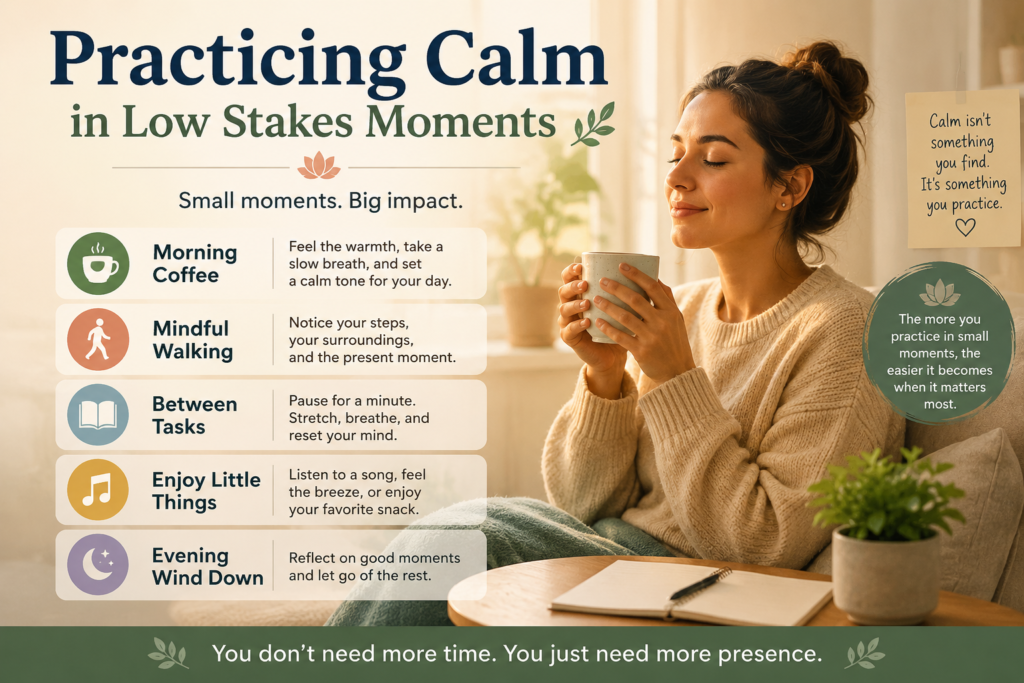
Practicing Calm in Low Stakes Moments
Most people think calm is something you save for emergencies. You try to be level headed during a job interview, a hard conversation, or a real financial scare. But that view makes calm feel like a switch you can flip on command. Usually, it is not. Calm is closer to a skill than a personality trait, and skills get built during ordinary repetitions, not dramatic moments.
That is why the better training ground for steadiness is not the crisis itself. It is the tiny daily mess. The coffee spill before work. The missing keys when you are already late. The email you forgot to send. The sinking feeling when you open your banking app and remember a bill you meant to handle. In moments like these, the nervous system is already beginning to practice a pattern. It either learns, “small disruption equals full alarm,” or it learns, “I can pause, assess, and respond.” The same kind of composure that helps with money decisions, including exploring options like personal loan debt relief, often starts with how you handle the very first sign of friction in an ordinary day.
When people ignore that connection, minor stress starts acting like kindling. One annoyance lights the next. You spill coffee, then snap at someone, then rush out the door, then forget something important, then tell yourself the whole day is ruined. None of those events, by themselves, deserves that much power. But together, they create a body and mind that stay on high alert. Practicing calm in those low pressure moments interrupts the chain before it becomes your default setting.
Calm Is Built in Repetition, Not Performance
Think about any other skill. You do not become strong by lifting one impossibly heavy weight once. You become strong by repeating manageable movements until your body adapts. Calm works in a similar way. A stressful event is not just a test of your composure. It is often a reflection of your previous reps.
This is what makes small irritations so useful. They are frequent enough to practice with, but usually safe enough that you can slow down and notice yourself. A forgotten password is annoying, but it is also a chance to catch the first wave of frustration. A traffic jam is inconvenient, but it gives you a live opportunity to unclench your jaw, loosen your shoulders, and stop narrating catastrophe in your head.
That repeated pause matters. Relaxation techniques such as slow breathing and progressive muscle relaxation are commonly used to help create the body’s relaxation response, which is the opposite of the stress response, according to the National Center for Complementary and Integrative Health overview of relaxation techniques. The point is not to become unbothered by everything. The point is to teach your system that activation does not have to take over.
Why Low Stakes Moments Are So Valuable
In a genuine crisis, you usually do not have much spare attention. Your brain wants shortcuts. It reaches for habits, assumptions, and familiar reactions. If your familiar reaction is panic, spiraling, or harsh self talk, that is likely what will show up first. If your familiar reaction is to breathe, orient, and take the next useful step, that pattern becomes more available under pressure.
Low stakes moments give you room to rehearse without the full cost of failure. You can experiment. You can notice, “When I rush, I make this worse.” You can test, “What happens if I stop for ten seconds before reacting?” That is a gift. It means the little moments are not interruptions to your self improvement. They are the practice itself.
This can be especially important for people who think they are “just bad under stress.” Often, they are not bad under stress. They are simply under practiced in recovering from activation. Recovery is its own skill. Noticing tension early is a skill. Reframing is a skill. Speaking to yourself with less drama is a skill.
The First Win Is Physical
Before your thoughts become a whole courtroom drama, your body usually speaks first. Your shoulders rise. Your breathing gets shallow. Your chest tightens. Your pace gets faster. If you wait until your mind has already built a story about disaster, it is harder to settle down. So start with the body.
A slow inhale and a longer exhale can create just enough space to prevent a chain reaction. You do not need a perfect meditation routine in your kitchen because you dropped a spoonful of oatmeal. You need five honest seconds. Put both feet on the floor. Exhale fully. Unclench your hands. Widen your gaze. These are small signals, but they tell your body the moment is frustrating, not dangerous.
There is evidence that slow, deep breathing may modestly reduce stress and lower levels of cortisol, and relaxation practices are often used to counter the effects of stress, as noted by the NCCIH page on stress and relaxation approaches. That does not mean every breath transforms your day. It means your body is trainable, and that is good news.
Reframing Without Pretending
Calm does not require fake positivity. You do not need to grin at every inconvenience and call it a blessing. What helps more is accurate reframing. Instead of “Everything is going wrong,” try, “One thing is going wrong, and I can handle one thing.” Instead of “I always do this,” try, “I am frustrated, and I am still capable of fixing it.” Instead of “This day is wrecked,” try, “This is a rough ten minutes.”
That kind of language matters because your brain listens to your narration. If every mistake becomes evidence that you are failing at life, your system stays inflamed. If a mistake becomes a problem to solve, your system stays more flexible. Calm people are not necessarily less emotional. Often, they are simply less committed to turning every inconvenience into an identity statement.
Small Stress Reveals Bigger Patterns
Low stakes moments can also expose where your life is already overloaded. If misplacing your keys feels like a personal collapse, the keys may not be the real issue. You may be exhausted, overscheduled, financially strained, or carrying a backlog of unprocessed stress. In that sense, these moments are diagnostic. They show you where your capacity is thin.
That is useful information. It might mean you need a better landing place for essentials near the door. It might mean you need more sleep. It might mean you need fewer decisions in the morning. It might mean part of your stress is practical, not just emotional. Calm is easier when your systems support it.
How to Turn Annoyance Into Training
Start by picking one category of daily irritation. Choose something common enough that you will actually encounter it, such as running late, tech glitches, clutter, or small money worries. When it happens, do not aim for perfection. Aim for a ritual.
Your ritual can be simple. Pause. One full breath in, one longer breath out. Name the problem in one sentence. Pick the next action only. That might sound like this: “I cannot find my keys. I am annoyed. Next step, check the kitchen counter and yesterday’s jacket.” That is not glamorous, but it is effective.
You can also practice after the fact. At the end of the day, ask yourself where the first spark happened. What made the irritation grow? What would have helped you interrupt it earlier? Reflection turns random stress into useful feedback.
The Real Goal Is Capacity
The point of practicing calm in low stakes moments is not to become impressively serene at all times. It is to build capacity. Capacity means more room between event and reaction. More access to judgment when you are under pressure. More ability to stay kind, focused, and practical when life gets loud.
And that kind of steadiness rarely appears out of nowhere. It is built while standing in the kitchen, looking for your keys, wiping up the coffee, reopening the email, and deciding that this moment does not get to run your whole nervous system. Those are not throwaway moments. They are training sessions hiding in plain sight.
The quiet truth is that big resilience is usually made from small recoveries. If you practice returning to yourself when the stakes are low, you are far more likely to find that path again when the stakes are high.