
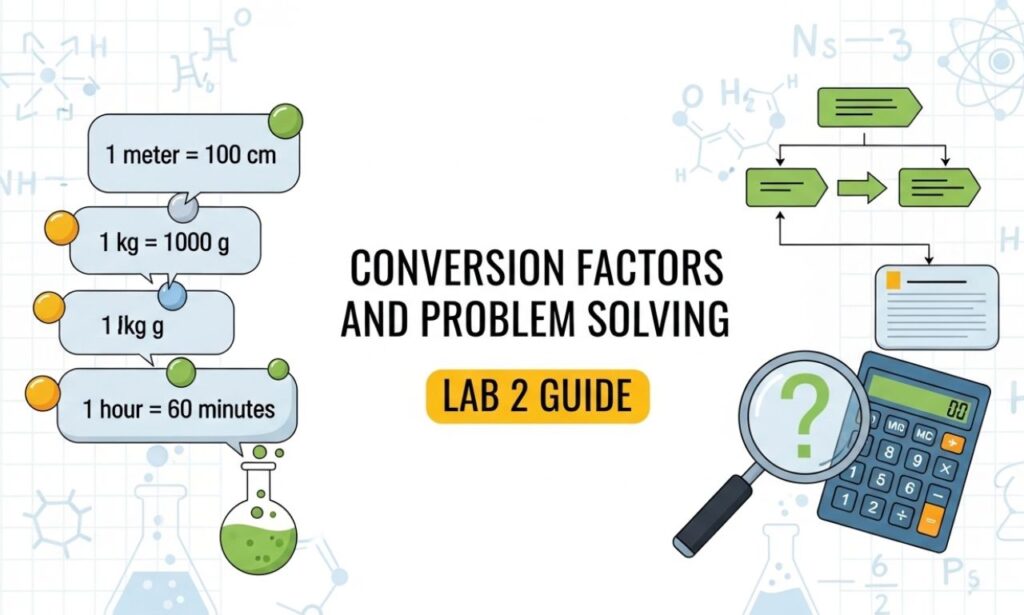
Conversion Factors and Problem Solving (Lab 2 Guide)
Conversi on factors are ratios used to change a measurement from one unit to another without changing its value. They are widely used in science and math to solve real-world problems involving units like length, mass, time, and volume.
In a lab setting, understanding conve rsion factors helps you correctly solve problems and record accurate results.
What Is a Conversion Factor?
A conversion factor is a fraction where the numerator and denominator represent the same quantity in different units.
Example:
-
1 meter = 100 centimeters
-
Conversion factor:
(1 m / 100 cm) or (100 cm / 1 m)
Both are correct because they equal 1.
How Conversion Factors Work
Conv ersion factors are used to cancel units step-by-step until the desired unit remains.
Key Rule:
Multiply by convers ion factors so that unwanted units cancel out.
Step-by-Step Problem Solving Method
Step 1: Identify the given value
Write down the number and its unit.
Step 2: Identify the target unit
Decide what unit you want the answer in.
Step 3: Choose
Use known relationships between units.
Step 4: Multiply and cancel units
Arrange the conversion factor so unwanted units cancel.
Step 5: Calculate the final answer
Solve the numerical part.
Example Problems
Example 1: Length Conversion
Convert 5 meters to centimeters
Solution:
1 meter = 100 centimeters
5 m×100 cm1 m=500 cm5 \text{ m} \times \frac{100 \text{ cm}}{1 \text{ m}} = 500 \text{ cm}
✔ Final Answer: 500 cm
Example 2: Time Conversion
Convert 2 hours to minutes
1 hour = 60 minutes
2 hr×60 min1 hr=120 min2 \text{ hr} \times \frac{60 \text{ min}}{1 \text{ hr}} = 120 \text{ min}
✔ Final Answer: 120 minutes
Example 3: Mass Conversion
Convert 3 kilograms to grams
1 kg = 1000 grams
3 kg×1000 g1 kg=3000 g3 \text{ kg} \times \frac{1000 \text{ g}}{1 \text{ kg}} = 3000 \text{ g}
✔ Final Answer: 3000 grams
Example 4: Multi-Step Conversion
Convert 2 kilometers to meters
1 km = 1000 m
2 km×1000 m1 km=2000 m2 \text{ km} \times \frac{1000 \text{ m}}{1 \text{ km}} = 2000 \text{ m}
✔ Final Answer: 2000 meters
Common Conversion Factors
-
1 km = 1000 m
-
1 m = 100 cm
-
1 cm = 10 mm
-
1 hr = 60 min
-
1 min = 60 sec
-
1 kg = 1000 g
Tips for Lab Success
-
Always include units in every step
-
Use proper conver sion factors
-
Double-check unit cancellation
-
Keep your work organized and neat
-
Write final answers with correct units
Common Mistakes to Avoid
-
Forgetting to include units
-
Using incorrect conversion ratios
-
Not canceling units properly
-
Skipping steps in calculations
How to Complete Your Lab Report Sheet
When filling out your lab report:
-
Write the given values
-
Show all conversion steps
-
Clearly cancel units
-
Box or highlight final answers
-
Ensure correct units are included
Conclusion
Conver sion factors are a powerful tool for solving measurement problems in science. By using step-by-step methods and proper unit cancellation, you can confidently solve any conversion problem in your lab.