
How Many Inches in a Foot: Understanding Feet and Inches
Understanding how many inches in a foot is a basic yet essential concept in measurement, especially in the United States and other countries that use the imperial system. A foot is a standard unit of length that has been used for centuries, and knowing its relationship with inches is crucial for everyday tasks such as measuring height, furniture, or construction materials.
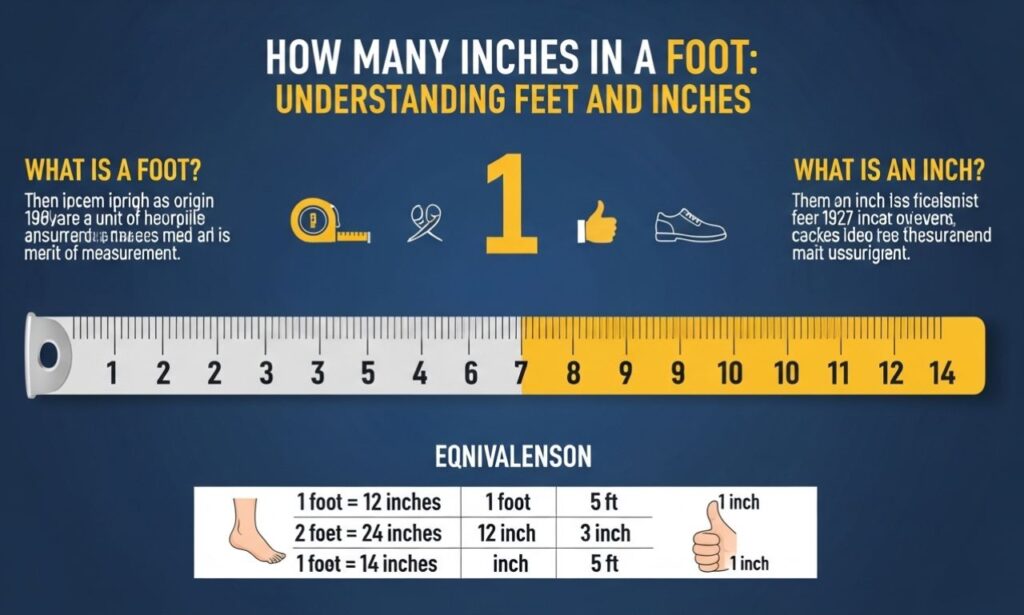
In simple terms, 1 foot equals 12 inches. This means that if you measure something that is 2 feet long, it is the same as 24 inches. This simpleconversion is fundamental in construction, tailoring, interior design, and various educational applications.
The History of the Foot
The foot as a unit of measurement dates back thousands of years. Ancient civilizations, including the Egyptians, Greeks, and Romans, used a “foot” based on the approximate length of a human foot. Over time, the measurement became standardized.
In 1959, an international agreement defined the foot as exactly 0.3048 meters, which is equivalent to 12 inches. This standardization helped create consistency across engineering, science, and construction projects worldwide.
Why 12 Inches in a Foot?
The choice of 12 inches in a foot is rooted in historical measurement systems. The number 12 has many divisors (1, 2, 3, 4, 6, 12), making it practical for dividing a foot into equal parts. This is why 12 inches became the standard in the imperial system, rather than 10, which is more common in the metric system.
How to Convert Feet to Inches
Converting between feet and inches is straightforward:
-
Multiply the number of feet by 12 to get inches.
-
Example: 5 feet × 12 = 60 inches
Conversely, to convert inches to feet:
-
Divide the number of inches by 12.
-
Example: 36 inches ÷ 12 = 3 feet
This simple formula allows quick calculations for DIY projects, construction measurements, and educational purposes.
Using Feet and Inches in Everyday Life
Knowing that 1 foot equals 12 inches is useful in many real-world scenarios:
-
Height Measurement: Heights in the U.S. are often expressed in feet and inches. For example, 5 feet 7 inches is 67 inches total.
-
Construction and Carpentry: Lumber, flooring, and other building materials often use feet and inches.
-
Interior Design: Furniture dimensions and room layouts require understanding this conversion.
-
Education: Learning the relationship between feet and inches is a key part of early math education.
Tips for Working with Feet and Inches
-
Remember the Basic Conversion: Always start with 1 foot = 12 inches.
-
Break Down Fractions: If a measurement includes fractions of a foot, multiply the fraction by 12 to convert it to inches.
-
Example: 2.5 feet = (2 × 12) + (0.5 × 12) = 24 + 6 = 30 inchesUse Tools: Measuring tapes and rulers often have both feet and inches for easy conversion.
-
Feet vs. Inches vs. Other Units
While feet and inches are part of the imperial system, other countries primarily use the metric system. For example:
-
1 foot = 0.3048 meters
-
1 inch = 2.54 centimeters
Understanding these conversions is helpful for international work, travel, and education.
Fun Facts About the Foot
-
The human foot influenced the original measurement, but foot lengths varied by country until modern standardization.
-
The word “foot” in measurement dates back to the 7th century.
-
Some historical systems had a foot of 11, 12, or even 13 inches depending on the region.
Conclusion
Knowing how many inches in a foot is a basic but essential measurement skill. With 12 inches in a foot, you can easily convert between these units for everyday use in math, construction, or design. Understanding this relationship also helps bridge the gap between the imperial and metric systems, making it easier to work with international standards.
Whether measuring furniture, calculating your height, or learning basic math, remembering that 1 foot equals 12 inches is a simple but important fact that makes life easier.